The TOCALO Group respects the human rights of all employees, business partners, and stakeholders and is committed to eliminating and preventing discrimination and harassment.
The Company complies with the minimum wage regulations of each country and region, and our Guidelines for Corporate Ethical Behavior state our obligations to employees and commitment to promoting their efforts to achieve their full potential and self-fulfillment.
Working conditions at TOCALO comply with and exceed standards set forth by laws and regulations.
The TOCALO Group is a company that sincerely and creatively promotes sound business activities and contributes to creating a flourishing society. The Corporate Code of Conduct stipulates ethical standards that all Group officers and employees are expected to follow.
The Code of Conduct states the Group's basic policy on human rights is to respect for basic human rights, prohibit discriminatory treatment and child and forced labor, and foster a workplace culture that recognizes diversity and individuality.
In accordance with the Code of Conduct, the TOCALO Group Human Rights Policy clearly states the Group’s responsibility to uphold human rights. The Group recognizes that any of its business activities has the potential to directly or indirectly infringe human rights. The president and chief executive officer are responsible for efforts to ensure human rights are respected for all people involved in its business activities.
- Respect for human rights
The Group respects internationally recognized human rights as stipulated in the International Bill of Human Rights and the International Labor Organization Declaration* on Fundamental Principles and Rights at Work. The Group complies with applicable laws and regulations in the countries and regions where we conduct business activities in accordance with the United Nations Guiding Principles on Business and Human Rights.
We respect the internationally recognized human rights when a contradiction exists between internationally recognized human rights and the laws and regulations of a country or region.
*Includes support and respect for core labor standards for the abolition of child labor, elimination of forced labor, elimination of discrimination, and recognition of freedom of association and the right to collective bargaining. - Scope of application
The Human Rights Policy outlines the Group’s responsibility to implement measures to respect human rights and applies to all officers and employees of the Group. The TOCALO Group expects all of its business partners to follow the policy.
- Human rights due diligence
The Group maintains a system for conducting human rights due diligence and identifies and takes steps to prevent and minimize actual and potential human rights infringements in the Group’s business activities and value chain.
The Group also appropriately discloses information about our human rights measures and their progress on our website and via other means. - Correction and remedy
If it becomes clear that a Group business activity has directly or indirectly caused, promoted, or been involved in a human rights infringement, we will take appropriate internal and external steps to correct and remedy the situation. We will additionally develop effective corrective and remedial mechanisms.
- Dialogue and discussion with stakeholders
The Group will engage in dialogue with various stakeholders about ways to improve its efforts to respect human rights based on Human Rights Policy.
- Education and training
We will provide Group officers and employees with appropriate education and training to ensure the Human Rights Policy is taken into consideration and effectively put into practice in all of our business activities.
June 23, 2023
Kazuya Kobayashi
President and CEO, Representative Director
TOCALO Co., Ltd.
The Group has established a structure for human rights due diligence and enforcement based on the United Nations Guiding Principles on Business and Human Rights. As a first step of enforcement, in fiscal 2023 the Group identified and prioritized action on potential human rights issues for each business activity.
- Organize potential business-related human rights issues with reference to the Universal Declaration of Human Rights, OECD Guidelines for Multinational Enterprises, ILO International Labor Standards, SA8000 Standard, Guidelines on Respecting Human Rights in Responsible Supply Chains, and related practical materials.
- Assess the severity and likelihood of each risk based on internal interview meetings to determine the awareness level of human rights risks; recommendations and requests from NGOs and other organizations; risks considered important by other companies in the industry and leading companies in Japan; and investigations and media reports on human rights issues.
- Discuss the risks with external experts
- Review the risks at Sustainability Committee meetings and identify priority risks (approved at the March 2024 Board of Directors meeting)
- Set five general risk categories of occupational safety and health, discrimination, community, information management, and intellectual property, and 28 risk scenarios.
|
Category |
28 risk scenarios |
|
Occupational safety and health |
Poor working conditions, occupational accidents, rights violations and restrictions, child labor, forced labor, law and regulation violations |
|
Discrimination |
Sex/gender, origin, nationality/ethnicity, ideology/beliefs, medical history/health (including pregnancy), physical/mental disability, employment status, discriminatory language, other |
|
Community |
Planning and technology development, raw material procurement, manufacturing and processing, public relations, sales and after-sales service, disposal |
|
Information management |
Inappropriate use, data leak, legal violations, security, technology/AI |
|
Intellectual property |
Proper compensation, inappropriate use |
- Evaluate and analyze the risks and create a risk map based on (1) severity* and (2) probability of occurrence
* Based on the scale and scope of the human rights violations and the difficulty to remedy the situation - Prioritize addressing high severity risks; when multiple risks of equal severity exist, prioritize by probability of occurrence
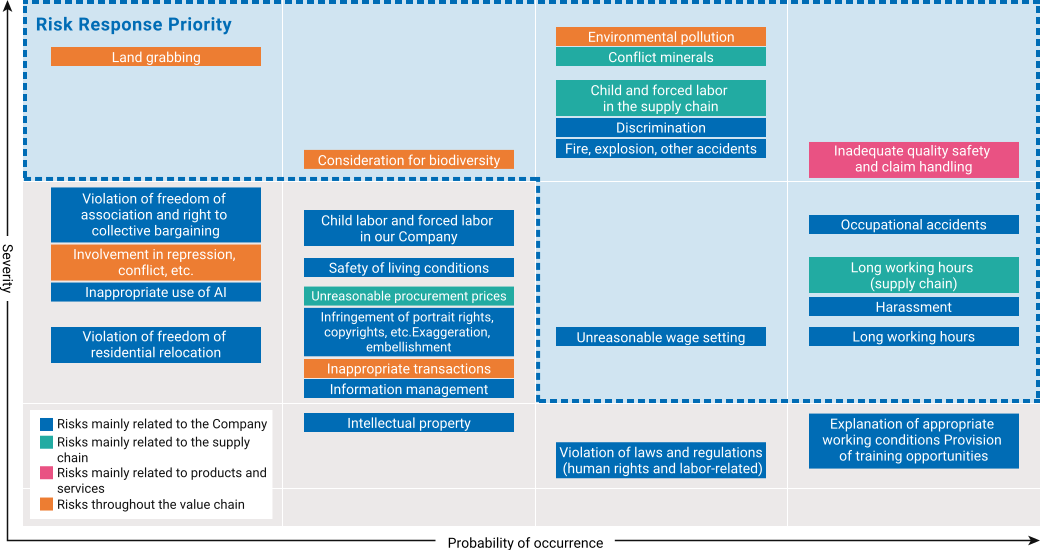
We conducted a survey about human rights violations to gain a better understanding of the current situation within the Group with regard to the priority risks that we have identified. We plan to use the results of this survey as the basis for internal training activities with a focus on issues that are less widely recognized as human rights violations. In addition, we have formulated the “Sustainable Procurement Guidelines” and distributed them to our suppliers. Going forward, we plan to conduct regular self-assessments to monitor progress on these initiatives.
We recognize occupational health and safety (including the handling of organic solvents, etc.), working conditions in the supply chain, and human rights risks at overseas locations as salient human rights issues in the manufacturing industry. Furthermore, we identify and review these issues by understanding them through dialogue with stakeholders, such as employees and suppliers.
To address identified human rights risks, such as occupational health and safety and working conditions in the supply chain, we implement measures to prevent, mitigate, and remediate these risks through the distribution of our Sustainable Procurement Guidelines, dialogue with suppliers, and employee education.We review these initiatives as needed based on their implementation status and make improvements where appropriate to strengthen our risk management.
The Compliance Handbook expressly stipulates that the company shall respect the fundamental human rights of employees and shall not discriminate against or harass individuals for reasons unrelated to the performance of one’s duties. This includes race, nationality, ethnicity, beliefs, religion, age, sex, sexual orientation, physical characteristics, presence or absence of disability, internal position, type of employment, property, place of origin, marital status, or any other reason that may harm the dignity of the individual. Furthermore, instructions have been given stating that reasons unrelated to the performance of duties cannot be made selection criteria during the new hiring of employees.
- Percentage of employees with disabilities
2.89% (non-consolidated, end of March 2026)
The Group supports the "Children's Rights and Business Principles" and is committed to protecting children's rights. In addition to strictly prohibiting child labor, we strive to prevent the infringement of children's rights and improve their welfare through our business activities, thereby contributing to the development of a healthy environment for their upbringing.
Based on our policy to implement fair and equitable treatment, we comply with relevant laws and regulations and ensure equal pay for equal work. We are committed to ensuring fair and appropriate treatment for all employees, regardless of their employment status. In addition, we aim to provide a living wage that meets the basic living needs of our employees.
We actively seek to increase employee awareness of human rights through compliance training (e-learning) for our employees. We have achieved a 100% participation rate for these activities. The training is designed to provide all employees with basic knowledge of the UN Guiding Principles on Business and Human Rights, human rights policy, and approach to respect for human rights. We also regularly conduct training on harassment prevention and corporate ethics awareness.
The Company facilitates relations between management and labor and promote its business by holding discussion meetings between company and labor union executives attended by company executives and labor union leaders about six times a year. Through these opportunities, in addition to sharing information on business plans, performance, and organizational changes, we hold discussions on human rights-related themes such as the labor environment, treatment, occupational health and safety, and compliance. To realize a better working environment and improved conditions, we record the details of these discussions in meeting minutes and reflect them in our measures. This ensures continuous improvement and the construction of sound labor-management relations.
In FY2025 (April 2025 to March 2026), no material human rights incidents or serious violations of labor standards were identified within our Group. We operate a whistleblowing system (Clean Line system) to ensure the early detection and remediation of human rights issues. The system includes both internal reporting channels and an external hotline managed by an independent third party. If any adverse human rights impacts are identified, we promptly conduct fact-finding investigations and, through appropriate procedures, take corrective actions and provide remedy, as well as implement measures to prevent recurrence. We disclose the number of consultations on our website.
For details, including the number of consultations, please refer to our Compliance.